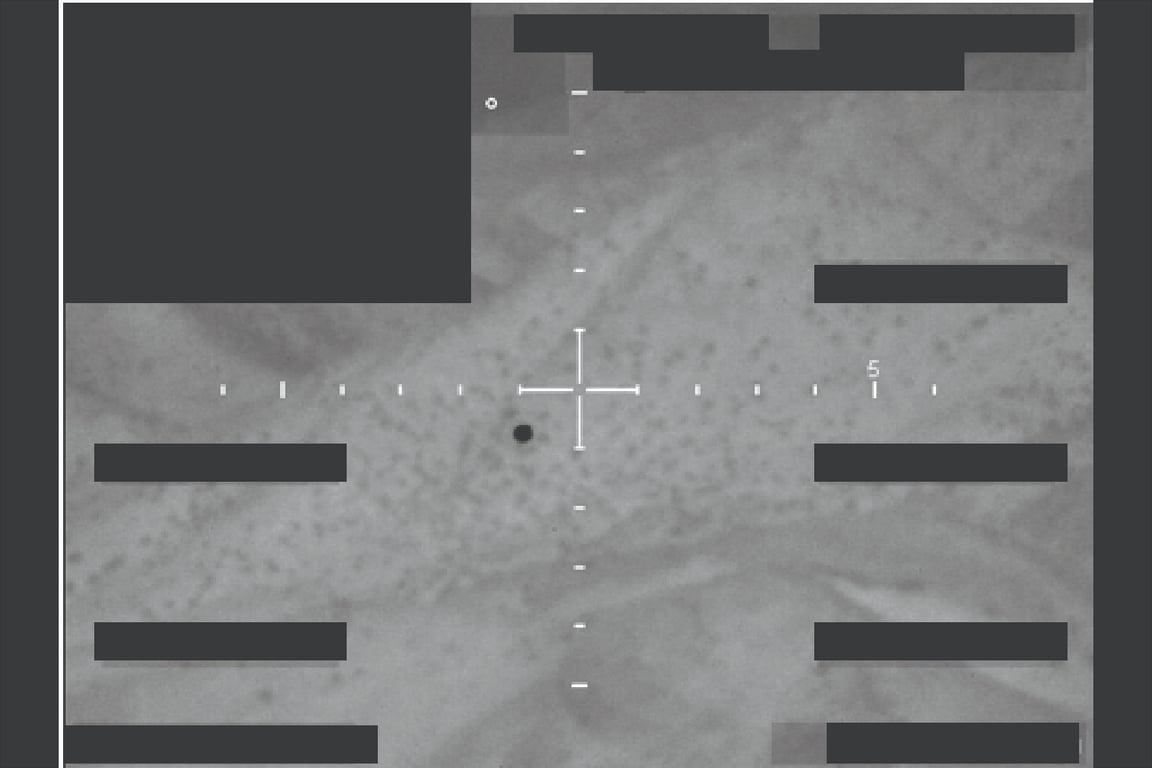
 Executive Summary: Recent U.S. releases of UFO/UAP files have revived public interest, but the footage so far has been inconclusive. Official analyses (NASA’s 2023 report and Pentagon studies) find “no conclusive evidence” of extraterrestrial technology in these sightings. Instead, experts point to mundane causes: how sensors and cameras work (and misfire), common objects like birds or balloons, and video artifacts. This article explains the key sensor technologies (radar, infrared, optical, satellites), how military systems detect and track targets, why many recorded UAPs are false positives, and why the videos look blurry. The aim is to demystify the “UFO” phenomenon through a technology lens, showing that the data so far does not prove anything extraordinary.
Brief Context: UFO/UAP File Releases
In May 2026 the Pentagon began posting batches of declassified Unidentified Anomalous Phenomena (UAP) records online. These files spanned decades of reports and included a few dozen videos and hundreds of pages of testimony. Media noted that most clips were the same blurry or old images already public. Retired officials and journalists immediately said the new videos showed “nothing unexpected”. In fact, even before these latest releases, the U.S. government’s own UAP office reported in 2024 that it found “no evidence” any sighting involved confirmed alien technology. NASA’s independent study in 2023 reached the same conclusion: so far there is “no conclusive evidence suggesting an extraterrestrial origin” for any UAP. In short, official sources emphasize that these files do not reveal spaceships or aliens, but they do highlight how our sensors and interpretation can be tricked.
What Is a UAP?
UAP stands for Unidentified Anomalous Phenomena, a term NASA adopted in 2022 to describe “observations of events in the sky that cannot be identified as aircraft or known natural phenomena”. (Before 2022, the phrase “unidentified aerial phenomena” was used.) In practice, a UAP is simply something seen on radar or camera that the observer cannot immediately explain. It does not imply anything supernatural; it literally means “we don’t know what this is yet.” The NASA report and Pentagon policy both stress that UFOs/UAP should be treated scientifically: first rule out all normal explanations before even considering exotic ones.
Key Military Sensor Technologies
Modern military platforms use several kinds of sensors to scan the sky. Each has strengths and quirks:
Radar (Radio Detection and Ranging): Military and civilian radars emit radio waves and measure reflections. Long-range surveillance radars and even civilian Doppler weather radars (the U.S. NEXRAD network, for example) can pick up flying objects. NASA notes that weather radar networks and geostationary environmental satellites are “essential for distinguishing interesting objects from airborne clutter”. Radar tells you an object’s range and speed, but small targets or overlapping echoes can be hard to interpret. New satellite radars (like the upcoming NASA-ISRO NISAR mission) promise high-resolution images of Earth and could capture UAP directly, but today most UAP reports come from existing radar systems not optimized for tiny unknowns.
Infrared/Thermal Cameras: Many aircraft and drones carry infrared (IR) sensors (e.g. FLIR) that show heat instead of visible light. These cameras “see” hot objects (engines, exhaust, warm bodies) against cooler backgrounds. IR can detect jet plumes or rocket launches that look dramatic. However, IR imagery can be confusing: a small hot spot on the ocean may appear as a fast-moving object. In one example from NASA’s analysis, an IR video made a floating sensor look like a “fast object,” but numerical data showed the apparent speed was mostly due to the moving camera. Official reports show many IR-based UAPs were mundane: for instance, two different U.S. Air Command cases in 2022 were quickly identified as “almost certainly a balloon,” based on the thermal signature and drift patterns. Other AARO cases closed with “not anomalous” when infrared targets matched normal aircraft heat signatures.
Electro-Optical (Visible-Light) Cameras: These include video cameras on jets, helicopters, and drones that record what our eyes would see. They often accompany IR sensors (a camera can output both IR and visible feeds). Visible-light cameras have familiar issues: lens flares, glare, focus problems and pixelation. Bright lights or reflections can make ordinary lights look like structured objects. A famous example: a released Pentagon video showed an “eight-pointed star” floating in the sky, but experts (including a former UAP chief) noted it likely came from a hot jet engine lens flare – “nothing more than a diffraction pattern”. In other cases, navigation lights from airplanes or helicopters can blur at distance and appear as glowing orbs. In short, optical sensors capture natural and equipment-induced artifacts easily mistaken for strange craft.
Satellites and Others: The military also has space-based sensors. Some satellites carry low-resolution cameras or infrared detectors (for missile launch warning, for example). Currently, those sensors are designed for large-scale events (like missile plumes or weather), so they generally cannot resolve a small drone or balloon unless it happens to be very hot. NASA’s report suggests future analysis might use its fleet of earth-observing satellites (and even telescopes) to check environments around reported UAP. For now, most UAP footage comes from aircraft and ground sensors, not satellites.
How Detection and Tracking Works
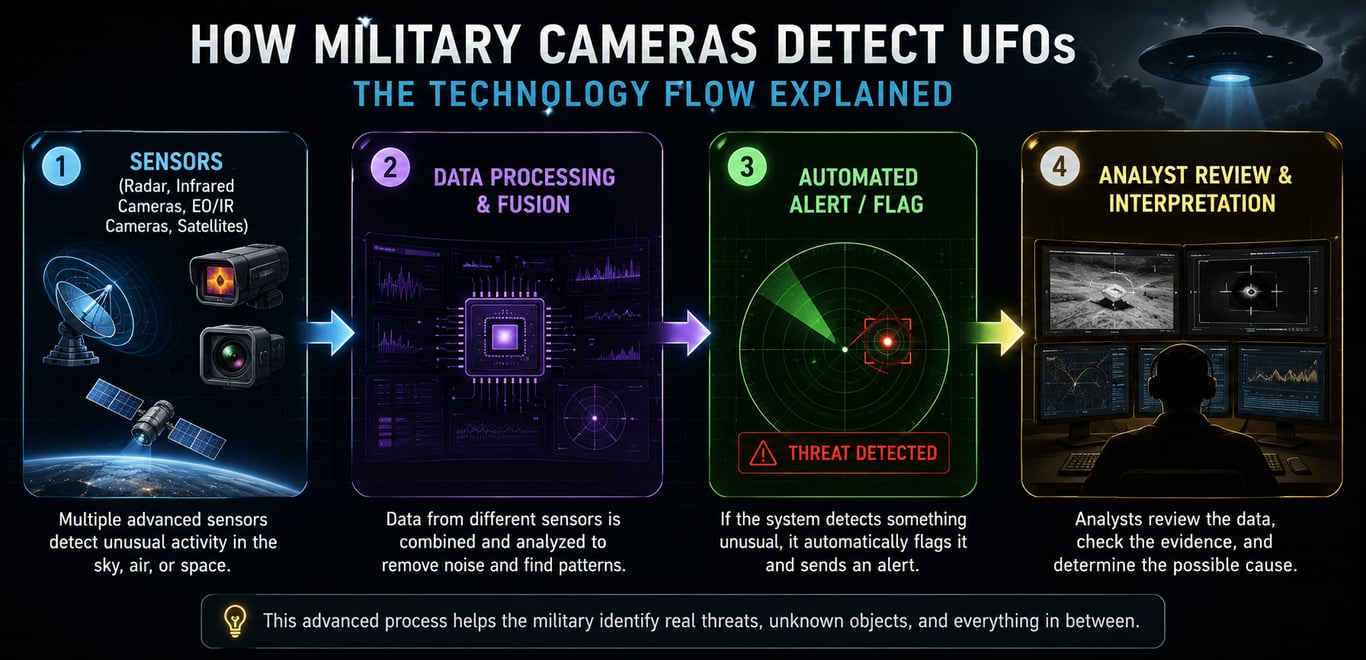
Unidentified objects in military operations usually show up as unexpected blips or images that are not immediately recognized. Modern systems use multi-sensor fusion: combining data from radar, IR, and video. For example, an AWACS radar might spot an object on radar; infrared cameras might then look for a heat signature at that location; and pilots with FLIR cameras record video. If the object has no known ID (not on any IFF transponder, for instance), it becomes a UAP report.
The All-domain Anomaly Resolution Office (AARO) and related groups gather these reports for analysis. Often the sensors trigger automated alerts: software flags objects moving strangely fast or maneuvering oddly. But as one former AARO chief warned, raw clips “without analysis ... will only serve to fuel more speculation”. In practice, analysts review incoming data by looking at multiple sources: radar tracks, camera metadata, witness accounts, etc., to try to identify each case.
Common Causes of False Positives
Experienced analysts note that many UAPs turn out to be entirely prosaic once all data are considered. Common explanations include:
Lens Flares and Camera Artifacts: Bright lights (sun reflecting off glass, engine exhaust, streetlights) can create flares or “starbursts” in video. As noted, one “UFO” was just a lens diffraction pattern from a jet. Small dust specks or smudges on a camera sensor or window can also cast odd shapes onto the image.
Compression and Processing Artifacts: Military video is often compressed for bandwidth. Compression can produce blocky artifacts or weird shapes (metabunk.org notes that the Navy “L-shaped” tic-tac UFO was likely a compression artifact). Frames can blur motion into streaks. Without raw footage, these effects can be hard to diagnose.
Motion Parallax and Camera Movement: A moving camera or zoom can make distant objects appear to move strangely. NASA’s report points out the “GoFast” video (of a fast dot seen by navy pilots) looked anomalous only because the sensor plane was moving; analysis showed the motion was consistent with the camera’s movement. In other words, if the camera fisheyes or oscillates, a stationary object can look like it’s accelerating.
Natural Phenomena: Atmospheric effects like ice crystals, clouds, or temperature inversions can bend light or reflect IR in odd ways. For example, heat mirages can produce bright blobs on IR sensors. Thermal stratospheric winds and reflections can mimic objects. (One 2023 IR case in the AARO listing was inconclusive; the heat signature might have been a thermal reflection or a genuine object, but the data didn’t resolve it.)
Birds, Insects, and Weather Balloons: In daytime or infrared, flocks of birds or insects swarming a jet can appear as a glint or heat image. Balloons (weather or reconnaissance) move slowly with the wind and often carry bright reflectors, looking like crawling lights on radar or tiny hot dots on IR. AARO explicitly resolved several cases as balloons. Drones (private or foreign) can also pop up on sensors; one official file even described an object in Syria that was later found benign (likely a drone or balloon).
Everyday Aircraft: Sometimes a UAP is just an airplane or helicopter seen at an odd angle. At night, navigation lights or landing lights may be confusing without context. An experienced observer once noted that a 2013 video of a star-like object in the Middle East was simply a hot jet engine – basically normal flight activity. In general, if an IR or video target behaves exactly like a conventional craft (constant speed, straight flight), analysts often classify it as “non-anomalous”.
In sum, most published UAP videos fall into these categories once looked at closely. The new Pentagon releases themselves included captions saying “no consensus about the nature of the anomaly” and cautioning viewers not to jump to conclusions.
Why UAP Footage Often Looks Poor or Blurry
Many leaked or released UAP clips are low-quality by design. Several factors contribute:
Low-resolution and Digital Zoom: Military surveillance cameras may not have high zoom or resolution for fast targets. When operators digitally zoom or stabilize, the picture can pixelate.
Compression and Transmission: Video from jets and drones is often compressed before recording or transmission. High compression introduces blockiness and motion smearing. A flickering or “swimming” effect on objects is common.
Infrared Palettes: In thermal footage, colder objects appear black (black-hot mode) or white (white-hot mode) against backgrounds. The color map can make it hard to see shape details. What looks like a round blob of heat might just be a distant airplane with a hot engine.
High Contrast & Saturation: Bright sky vs. dark landscape causes glare and blooming in cameras. Overexposure or noise can hide details, making objects appear as featureless dots.
As NASA put it, their analysis was hampered by “poor sensor calibration” and missing metadata. The released files often lacked information like exact location, distance, or camera angle, so judgments are guesswork. Any random mark or glare can look mysterious without scale.
Practically, this means videos of UAP tend to look like tiny, wobbly lights. Even NASA emphasizes that “new and robust data acquisition” is needed to properly study UAPs. In other words, the current footage is simply not good enough to prove anything extraordinary – it usually just provokes confusion.
AI and Automated Analysis
Given the large volume of data (radar blips, infrared video, pilot reports), analysts hope AI and machine learning can help. NASA’s study notes that AI/ML tools are “essential” for spotting rare events like UAP in vast datasets. For instance, an AI model might flag a fast-moving infrared pixel or an unusual flight track. However, both NASA and defense experts caution that AI only works on high-quality data. The UAP study team warned that “at present, UAP analysis is more limited by the quality of data than by the availability of techniques”. In many Pentagon files, the raw sensor data are incomplete or lack context, making AI false alarms likely.
Another limitation is that current AI is typically trained on known objects and clutter. It may not recognize a truly new class of phenomenon if the input data is noisy. Automated systems also produce many false positives (e.g. AI might flag lens flares as potential targets). Therefore, human analysts still review most reports. AI can assist by scanning footage and logs, but final identification often relies on expert judgment.
Balanced Conclusion: No Alien Proof Yet
In conclusion, the military-grade sensors (radar, infrared, optical) do sometimes see objects they can’t immediately explain, hence the term UAP. But in nearly all documented cases so far, a conventional explanation has emerged once all data were considered. Official studies agree: to date there is no evidence that any UAP report has involved alien technology. Instead, sensor quirks, atmospheric phenomena, wildlife, balloons and drones explain almost all sightings.
This doesn’t mean the phenomenon is uninteresting — it means it is mostly a problem of data and analysis. Better sensors, clearer video, and systematic data collection will improve clarity. For now, we must be cautious: most released UAP footage is low-fi and often reflects known physics or objects. As one analyst put it, extraordinary claims require extraordinary evidence, and the released files simply don’t provide it.
Internal Resources: For readers interested in the tech side of video and imaging, our best GPU guide covers how powerful graphics cards speed up video processing. For camera-based tracking, check out our VTube Studio + NVIDIA Broadcast setup guide, which explains sensor pipelines in a different context. And for more on gadgetry and sensors (including drones and wearable tech), see our article on smart gadgets for students.
SEO Meta Description (en-GB): Explore how military radar, infrared, optical cameras and satellites can trigger UFO sightings. This tech-focused analysis explains sensor detection and false positives behind UAP videos, and why official sources say there’s no evidence of extraterrestrial craft.
FAQs:
What did the Pentagon’s UFO file release actually show?
The 2026 declassified files contained decades-old UAP videos and reports, mostly showing blurry lights or dots. Officials and experts noted many were already public or easily explained, and the release did not reveal any aliens.
How do military sensors detect objects?
Militaries use multiple sensors in tandem: radar for range/speed, infrared cameras for heat signatures, and optical cameras for visuals. Data from all sensors can be fused automatically. Alerts go off when something unusual appears, but analysis is needed to identify it.
Why are UFO videos usually low-quality?
Jet and drone cameras often have limited resolution, heavy compression, and high-contrast lighting. This makes any small object look grainy or distorted. Thermal imaging can also overexpose bright areas. Experts say these issues, plus common lens flares and artifacts, mean most UFO clips can’t definitively show anything strange.